The American physician Frank Lynn Meshberger was the first to discern a human brain hidden within the celestial “cloud” enveloping God during the creation of Adam. In October 1990, Meshberger published a seminal article in the Journal of the American Medical Association (JAMA) titled “An Interpretation of Michelangelo’s Creation of Adam Based on Neuroanatomy.” Within its pages, he revealed how the billowing cloak and angelic figures surrounding the Almighty in the Sistine Chapel fresco trace, with uncanny precision, a sagittal cross-section of the human brain—intimating that the Creator is bestowing upon Adam not merely the breath of life, but the gift of intellect and consciousness.
I could take Meshberger’s idea a step further: if this heavenly shroud is indeed a cross-section of the mind, then God becomes a vital part of that whole—a vast, primordial neuron reaching out to forge a connection with a nascent cell, which is Adam. Remarkably, the divine fingertip never quite meets the human phalanx, mirroring the way neurons engage in a synapse: uniting across a divide without ever touching. It is a poetic resonance that bridges the silent void between those two outstretched hands with the very architecture of our nervous system.
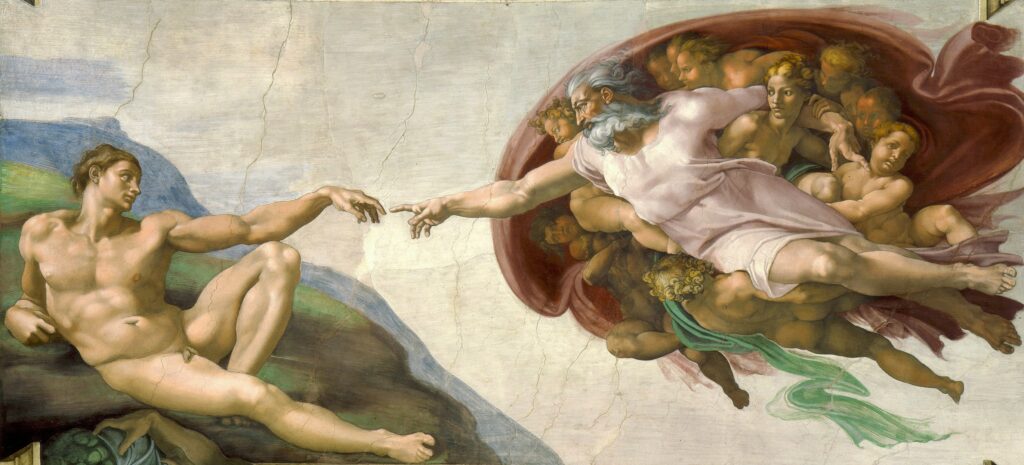
- The synaptic cleft: The slender chasm separating God’s fingertip from Adam’s stands as the exact visual echo of the synaptic cleft. In the quiet alchemy of a chemical synapse, neurons never physically collide; instead, they release neurotransmitters across that microscopic abyss to carry a message and spark the neighboring cell to life.
- The “spark” of consciousness: Just as an electrochemical impulse leaps across the synaptic gap to awaken a dormant neural pathway, Michelangelo’s timeless gesture captures the surge of thought, soul, and existence flowing into Adam without the need for physical touch.
- The contrast of states: Within the fresco, God—cradled inside the anatomical folds of the brain—is rendered in dynamic motion, taut and brimming with kinetic vigor, much like an active presynaptic neuron. Adam, by contrast, reclines in languid stillness, a resting postsynaptic neuron poised to receive the charge that will stir him into being.
- A stroke of anachronism: Perhaps the most breathtaking facet of this reading is its defiance of time. Michelangelo breathed life into this ceiling around 1511, centuries before the existence of the synapse and the space between neurons would be unveiled to science in the late nineteenth century by Santiago Ramón y Cajal and Charles Sherrington.
Leave a Reply