Category: + Concepts
-
The Awakening of Consciousness through Art
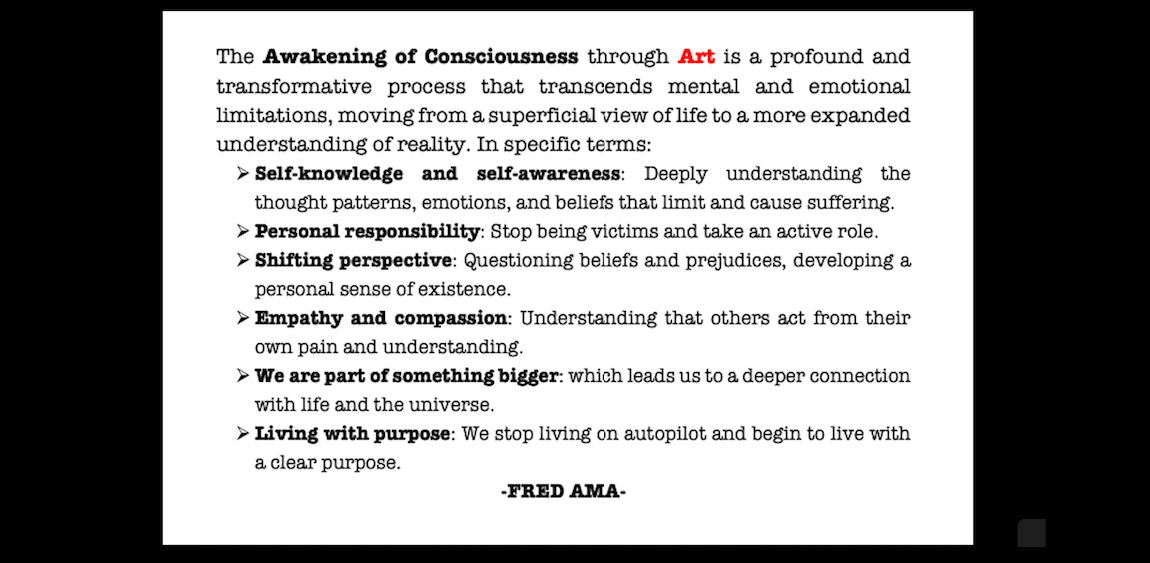
The Awakening of Consciousness through Art is a profound and transformative process that transcends mental and emotional limitations, moving from a superficial view of life to a more expanded understanding of reality. In specific terms: Ø Self-knowledge and self-awareness: Deeply understanding the thought patterns, emotions, and beliefs that limit and cause suffering. Ø Personal responsibility:…
-
-

Modernism, Postmodernism & Contemporaneity: 120 years of Art.
Modern Art (1904-1964): Begins with the first European avant-garde movements (especially developed in Paris) and was produced as a direct result of Impressionism and Post-Impressionism, as artists tried to respond to the “Demand for Contemporaneity” that the plastic arts had abandoned. The various manifestations: Fauvism, Expressionism, Cubism, Futurism, Dadaism & Surrealism give varied responses with…
-

THE PAINTING AS A WINDOW OR MIRROR???
In the Renaissance, Alberti describes painting as an open window that allows a three-dimensional world to be seen through a two-dimensional plane, i.e., the illusion of depth and reality, where the viewer can “look” into the depicted scene as if looking through a frame. The window metaphor explains how linear perspective makes objects appear smaller as they…
-
-
The Change of Role in Art
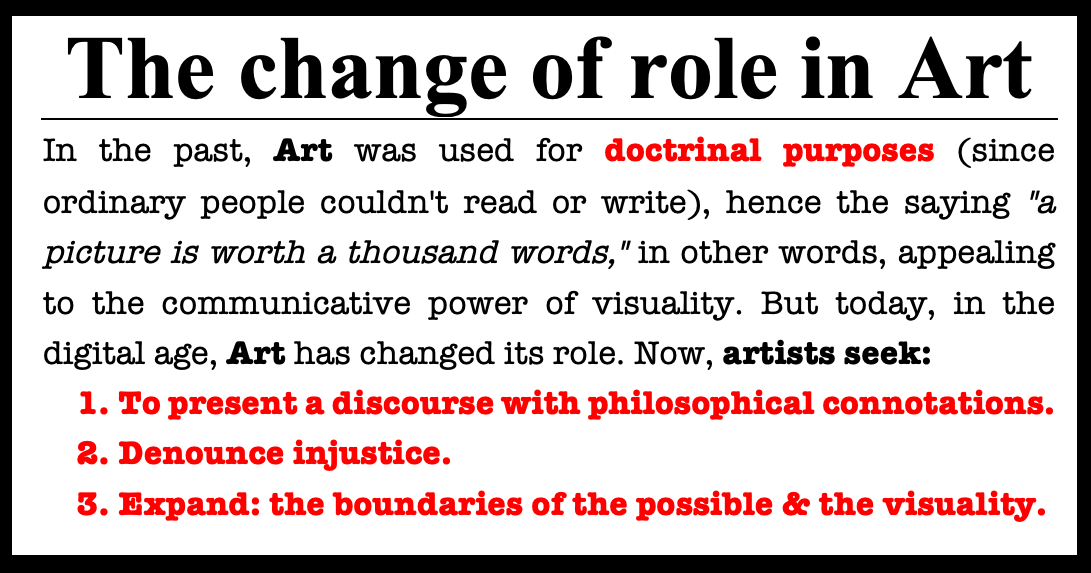
In the past, Art was used for doctrinal purposes (since ordinary people couldn’t read or write), hence the saying “a picture is worth a thousand words,” in other words, appealing to the communicative power of visuality. But today, in the digital age, Art has changed its role. Now, artists seek:
-
-
-
Art as Immanent Religion
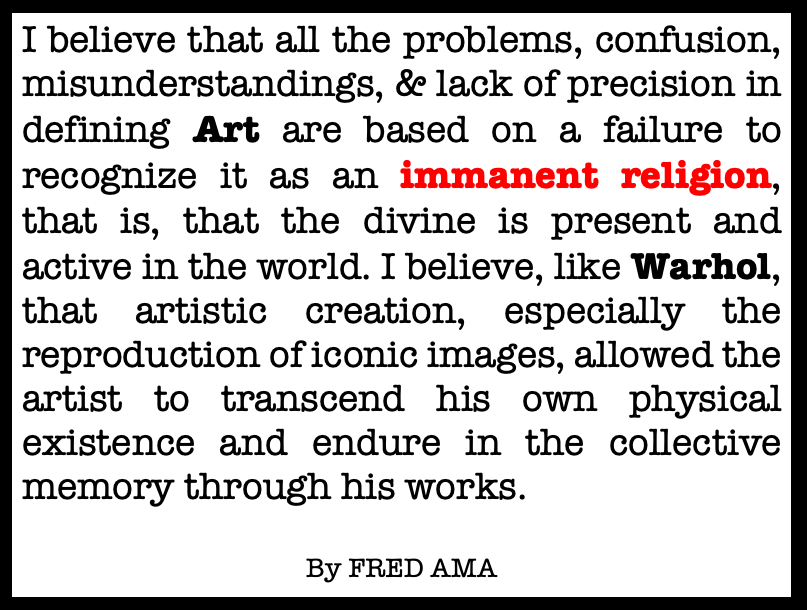
I believe that all the problems, confusion, misunderstandings, & lack of precision in defining Art are based on a failure to recognize it as an immanent religion, that is, that the divine is present and active in the world. I believe, like Warhol, that artistic creation, especially the reproduction of iconic images, allowed the artist…
-
Suprapictorialism considers Art as a Religion
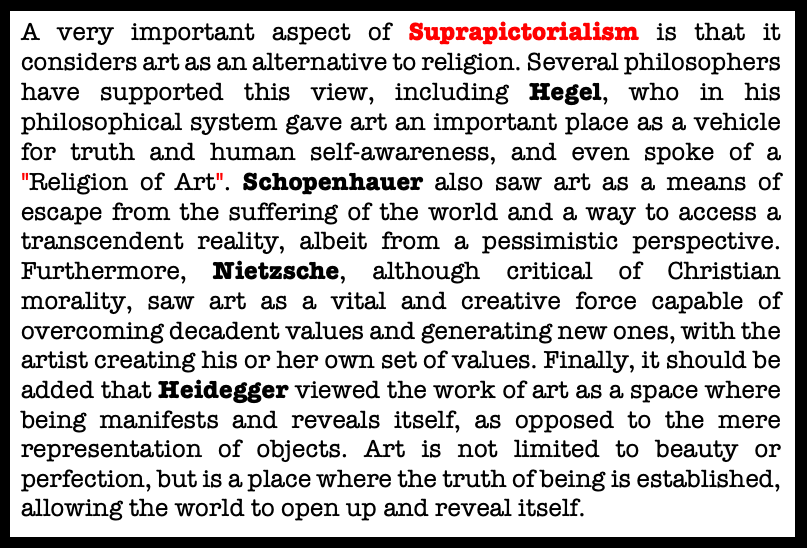
A very important aspect of SUPRAPICTORIALISM is that it considers Art as an alternative to religion. Several philosophers have supported this view, including Hegel, who in his philosophical system gave art an important place as a vehicle for truth and human self-awareness, and even spoke of a “Religion of Art.” Schopenhauer also saw art as…