New Paths
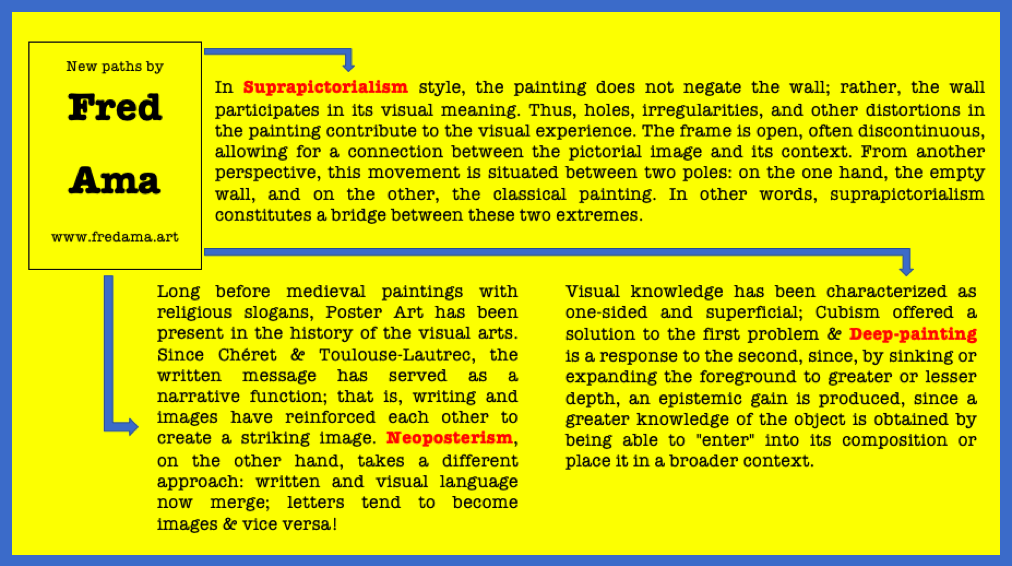
Suprapictorialism: 1. We distinguish between the pictorial image and the totalizing image; we are interested in the latter. 2. Painting is not the negation of the wall, but rather the wall participates in its meaning. 3. Therefore, painting can present holes, irregularities, and other distortions. 4. The frame is open, often discontinuous, allowing the union between the pictorial image and its surroundings, thus achieving the totalizing image. 5. The above can be applied to all types of abstract and figurative expressions. 6. At least, in some spots…paint and wall will come together.
In April 2023 I wrote “Visual knowledge is unilateral and superficial. Cubism gave an answer for the first, for the second I paint” Today I can offer a visual answer to the second question. Perhaps it won’t be immediately clear, but the idea is to move the foreground, parallel or obliquely, to the background of the painting. By doing so, certain objects and figures are cut off, allowing us to see and analyze deeper layers of what is traditionally only seen superficially. I call it “Deep-painting”.
Long before medieval paintings with religious slogans, Poster Art has been present in the history of the visual arts. Since Chéret & Toulouse-Lautrec, the written message has served as a narrative function; that is, writing and images have reinforced each other to create a striking image. Neoposterism, on the other hand, takes a different approach: written and visual language now merge; letters tend to become images & vice versa!
Leave a Reply